

The people behind Minha Entrada

When you start out in digital marketing, the first things you come across are channel names and loose words, and it is hard to see how they fit together.
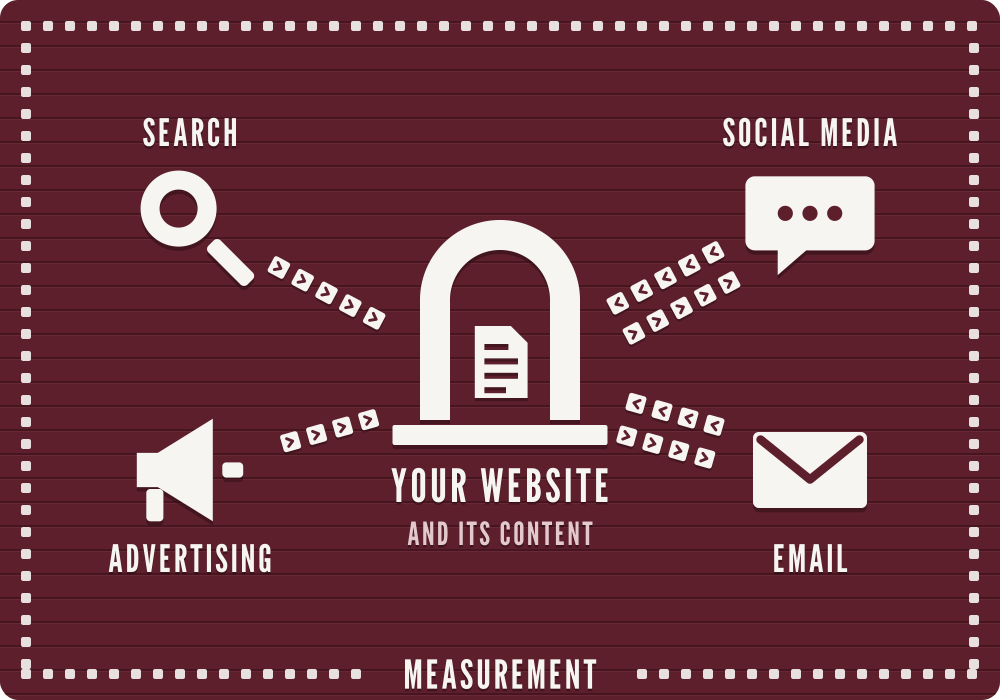
Here is the complete map: your website at the center, the channels that bring people to it, and measurement, which watches over the rest. For each part you will see what it is, what it asks of you and how it is read, and at the end, how they all work together. Each term is explained the first time it appears.
The system in one picture
The center of the system is your website with what you publish on it: it is your owned content, because it sits in a place you control.
Around it are four channels. Search brings people who are already looking for something; advertising brings people who see your ad. Social media and email go both ways: they bring people to your site, and from it someone can follow you or join your subscriber list. Almost all of those paths end in a click.
- Owned content
- What you publish in a place you control, such as your website.
- Subscriber list
- The email addresses of the people who asked to receive your messages.
- Click
- Pressing a link, a button or an ad to open what is behind it.
Everything sits inside measurement, which brings no one but tells you where each visit came from and what it did.
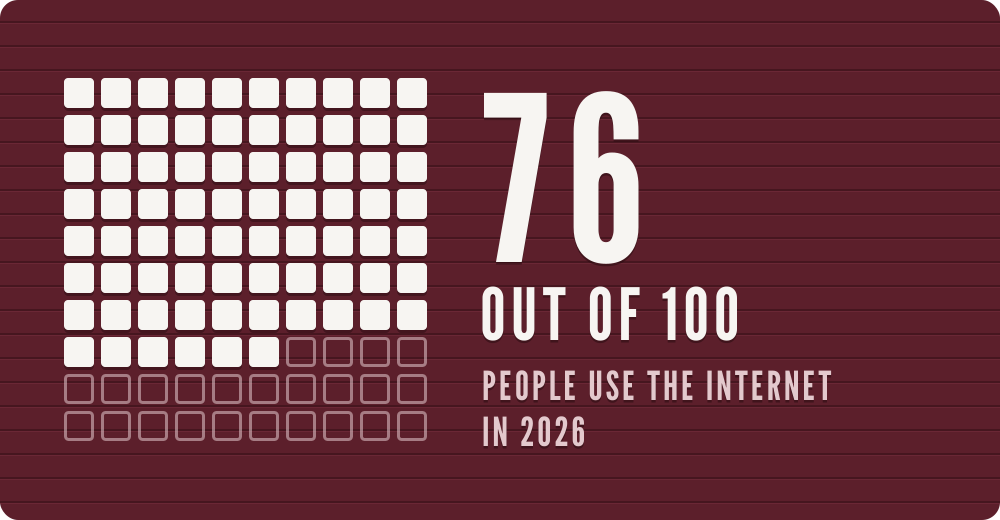
On the other side there are a lot of people: according to the International Telecommunication Union (ITU), 76 out of every 100 people use the internet in 2026.
We will use a made-up example to illustrate: a bicycle repair workshop with a simple website.
Next step: think about what the center of your own project is.
Organic search: being found when people look for you
Whoever types something into a search engine gets a list of results. The organic ones are the ones that are not ads: the search engine ranks them on its own. Each time your page appears in that list counts as an impression. Helping the search engine understand your content is called SEO.
- Organic
- What appears without anyone paying for that spot.
- Impression
- Each time your page or your ad appears on a screen, whether or not it is opened.
- SEO
- Helping search engines understand your content and helping people find your site.
Google’s guide to how Search works, updated in December 2025, describes three stages: crawling the pages, indexing them (analyzing and storing them) and serving results, ranked by hundreds of factors, such as the language or the location of the person searching.
This channel asks for time and patience. Google does not accept payment for position and does not promise that a page will appear, and its SEO starter guide, from the same date, explains that some changes take hours and others, months. The workshop cannot buy the top spot for “bicycle repair”.
It is read with Search Console, a free Google service that, as of November 2026, shows impressions, clicks and average position (the place where you usually appear); there are others like it.
Next step: search for your project the way someone who does not know you would.
Content: what you have to say
Content is what the other channels carry: the page that search shows, the post on a social network, the link in an email, the page an ad leads to.
It asks for time, knowledge of your subject and consistency. Google’s guide to helpful content, updated on November 11, 2026, says that its systems are designed to prioritize “helpful, reliable information that’s created to benefit people”.
For the workshop, content is a guide to cleaning the chain, or the page with its opening hours. It is read through measurement: visits per page and per channel.
Next step: write down the questions people ask you most; each one can become a page.
Social media: being where people already spend time
A social network is a platform where people post, share and talk. Facebook’s Help Center, consulted in November 2026, calls organic reach the number of people who saw an unpaid post, and paid reach the number who saw a paid one. When you pay, you also choose who it is shown to, for example by their interests: that is targeting.
- Reach
- How many people saw a post on their screen.
- Paid
- What appears because someone paid for that spot, like an ad.
- Targeting
- Choosing who an ad is shown to: by what they searched for, by their interests or by a visit to your page.
It asks for consistency and for accepting that the platform decides a good part of who sees what: YouTube’s help (consulted in November 2026) explains that its system “compares your viewing habits with those that are similar to yours”. The workshop can post the before and after of a repair.
It is read through reach, interactions (reactions, comments) and visits to your site. Which networks are used most changes from one country to another; DataReportal publishes a report for each country.
Next step: look in your country’s report to see which networks are used most.
Email: talking to people who asked for it
Email is for talking again to people who already know you and asked to receive your messages. Mailchimp, one of the many sending services, sums it up in its help, consulted in November 2026: “Permission is express, verifiable consent to receive marketing communication.”
It asks for a list built with permission. Mailchimp offers a two-step confirmation (the person subscribes and then confirms their address with a link), and every email carries a link to unsubscribe.
The workshop sends an email with each new guide, and that email brings the person back to the site. It is read through open and click rates (how many people open the email and how many press a link), which are approximate: according to Mailchimp, counting opens relies on images.
Next step: if you have a list, check that you know how each person subscribed.
Paid advertising: paying to appear
Here you pay for your ad to appear. In Google Ads, Google’s advertising platform, each search opens an auction; according to its help, consulted in November 2026, the bid (the most you offer) is one of six factors, alongside the quality of the ad and the context of the search. There are other platforms, such as Microsoft Advertising.
On search engines you usually pay only for each click: that is CPC, the cost per click, and you are often charged less than the maximum you set. CTR tells you whether an ad interests people; Google Ads help (November 2026) gives an example calculation, not a typical value: 5 clicks in 100 impressions make 5%. These ads are often called SEM.
- SEM
- Search engine marketing; it almost always means search ads, and sometimes SEO as well.
- CPC
- The cost per click, what you pay each time someone clicks your ad.
- CTR
- Clicks divided by impressions.
You can show your ads to people who searched for something specific, by their interests or because they visited your page. The workshop, for example, can show them to people who search for “bicycle wheel repair”.
It asks for a budget that you set; when it runs out, the ads stop showing. It is read through impressions, clicks, CTR and CPC, and through what those people did on your site.
Next step: read the explanation of the auction in Google Ads help.
Measurement: knowing what happened
An analytics tool collects data from your site: how many visits arrive, from which channel and what they do. As of November 2026, Google Analytics is one of them, and there are others. Each platform has its own rules about getting your visitors’ permission to measure; Analytics explains them in its help on consent mode.
Each visit goes into a group according to where it came from; the Analytics list, consulted in November 2026, includes organic search, paid search, social media, email and AI assistant, among others. Labels added to your links tell which campaign a visit comes from.
The most useful thing is to decide which action matters to you. As of November 2026, Analytics calls it a key event; in advertising it is called a conversion. From there comes the conversion rate; Google Ads help (November 2026) gives another example calculation, not a typical value: 50 conversions in 1,000 interactions make 5%.
- Key event
- The action on your site that matters most to you and that you decide to follow closely.
- Conversion
- That same action, when it is used to measure an advertising campaign.
- Conversion rate
- The share of interactions that ends in a conversion.
For the workshop, it could be a message sent from its contact page. Measurement asks you to set it up once and to get into the habit of looking.
Next step: write in one sentence what your key event would be.
The channels at a glance
| Channel | What it is for | What it asks of you | How it is measured |
|---|---|---|---|
| Organic search | Being found by people already searching | Time; it cannot be bought | Clicks, impressions, CTR, average position |
| Content | Giving the others something to show | Time, knowing the subject, consistency | Visits per page and per channel |
| Social media | Being discovered and having conversations | Consistency | Reach, interactions, visits |
| Going back to people who asked for it | A list built with permission | Opens and clicks, approximate | |
| Paid advertising | Appearing right away | A budget that you set | Impressions, clicks, CTR, CPC, conversions |
| Measurement | Knowing what happened | Setting it up and looking regularly | Key events, visits per channel |
Each channel asks for something different, and they all end up in measurement, where they are compared.
Next step: mark in the table the channels you already use.
How they connect: the path of one person
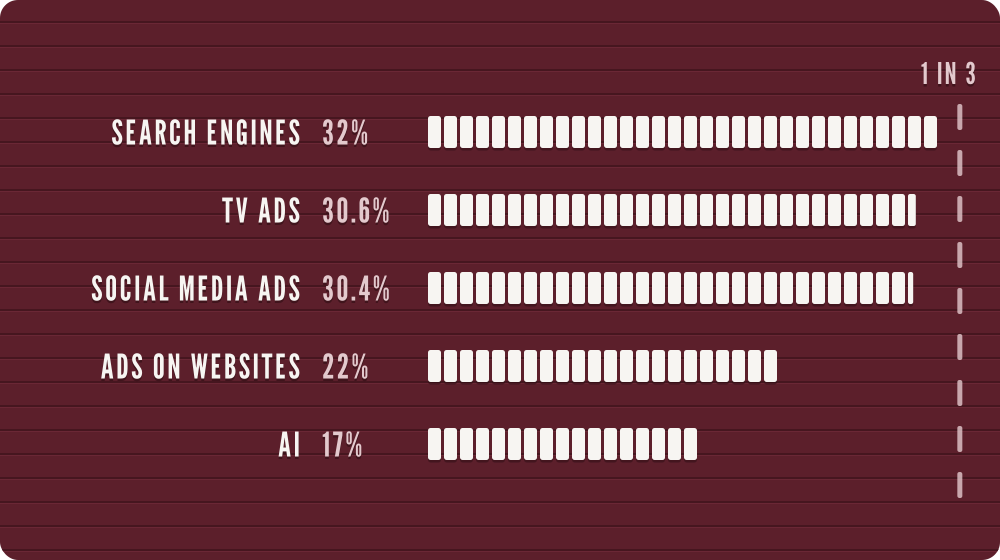
People do not use a single channel: in the survey in the figure, no channel reaches 1 in 3 internet users as a way of discovering new brands.
No channel works alone: each one leads to the others.
To put the ideas in order, follow the path of one person in four stages: discover, get to know, decide and come back. Many guides draw it as a funnel.
- Funnel
- A drawing of the steps a person goes through before doing something, wider at the top because fewer people take each step.
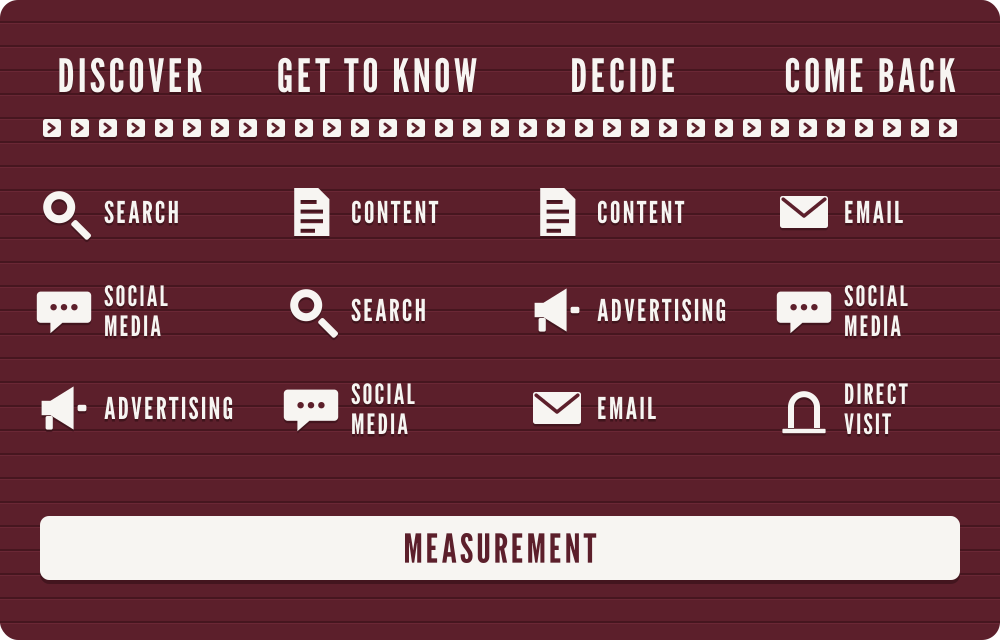
At the workshop, someone searches for how to adjust their bicycle’s gears and finds a guide (discover). They read others and see the workshop on a social network (get to know). Days later they see an ad, because they already visited the page, and look at the opening hours (decide). After the repair they subscribe and come back with each email (come back).
Almost nobody follows this order: Google Analytics help (consulted in November 2026) points out that a person may make several searches and click several ads before making up their mind.
Next step: think about which stage the last person who reached your project was at.
Where to start looking at your own system
With this map in front of you, you can draw your own on a sheet of paper:
- Your base. Write in the center where you publish what you want people to find.
- The channels that already bring you someone. Draw an arrow for each one.
- The action that matters. Write down your key event: a message, a visit to your opening hours, a download.
- What you already measure. Note which figures you see today and where.
Then choose a single channel to understand better. No one can promise you a specific result; the map helps you see where you are.
Questions that come up when you start
Do I need to be on every channel?
No. Each channel asks for time, a budget or consistency. According to DataReportal’s Digital 2027 report (October 21, 2026), a connected adult turns to an average of 5.82 channels to discover brands: that describes people, not something you have to do. Start with your base and one channel you can keep up.
What is the difference between organic and paid?
Organic appears without you paying for that spot, like a search result; paid is a spot bought as an ad. Measurement counts them separately.
Are SEO and SEM the same thing?
No. SEO helps search engines understand your content, and a place in the organic results cannot be bought. SEM usually means search engine ads, with their auction and their cost per click.
What is a conversion if I do not sell anything?
Any action that matters to you can be your key event: a message, a download or a visit to your opening hours. Google Analytics help, consulted in November 2026, puts it this way: “Any event you collect can become a key event.”
Who writes this guide
The people behind Minha Entrada. We are the team that writes Minha Entrada. We explain digital marketing step by step, with the platforms’ own documentation and sources that we cite with their date. When something changes or we find a mistake, we correct the article and show it with the update date.